Products»Whetstones»ATOMA Diamond»
ATOMA
140
89,00 €
Immediately available
(43)

Most users know that a sharpening stone needs to be flattened regularly, but many are surprised at how quickly a stone can wear uneven. Even if you can’t see any visible hollow, it can form after just 1–2 uses. This reduces the contact between the stone and the knife, making sharpening less effective.
The rate at which a stone wears depends on the hardness of the stone, your sharpening technique, and the type of blade being sharpened.
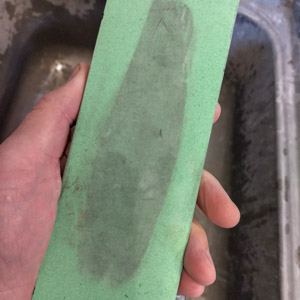 I often show customers this green Naniwa Pro 400 stone as an example. After sharpening several knives in a row, you usually notice—at the latest when progress slows down—that the stone has developed a hollow. The uneven surface often only becomes clearly visible once you start flattening it.
In this guide, you’ll learn how to flatten your sharpening stone efficiently and what to consider when choosing a flattening stone. Flattening is an essential part of stone maintenance – without it, you won’t get the performance you paid for.
The answer is: not perfectly – but flat enough.
If you know what you’re doing and understand how uneven wear affects sharpening, you can manage surprisingly well. In practice, the most important thing is that the center area of the stone is flat.
A good rule of thumb is about 6 cm from the center in both directions, meaning roughly a 12 cm flat area on a standard-sized stone. This is enough for effective sharpening.
Small uneven areas at the ends of the stone usually don’t matter. These are often caused by incorrect flattening technique or a warped flattening stone.
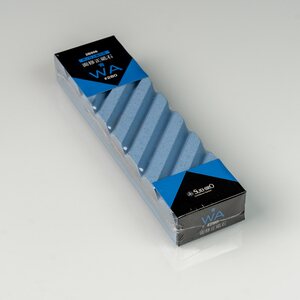
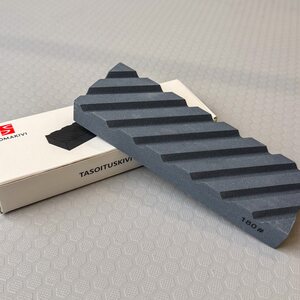
Choosing the right flattening stone is not just about grit.
A common misconception is that grit alone determines performance, but in reality, the composition of the stone matters more. Some sharpening stones clog most flattening stones, leaving diamond plates as the only effective option.
Particularly challenging are very hard and coarse stones, such as Shapton Kuromaku 120.
Diamond plates are effective, but they are not always necessary solely for flattening. For example, the Atoma 140 works well both as a flattening tool and as a coarse sharpening stone.
Many customers end up choosing this solution because one tool does two jobs: flattening and heavy material removal. This is often the point where sharpening really starts to work.
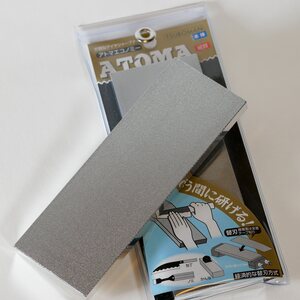 Products»Whetstones»ATOMA Diamond»
ATOMA140
89,00 €
Immediately available
(43)
Basic rule:
If you are using a slurry-type sharpening stone, it can be flattened with almost any coarser flattening stone.
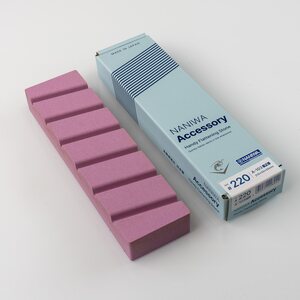
The challenge begins with hard, fully ceramic stones. One effective option for these is the Naniwa PA flattening stone, which is just powerful enough for stones like Shapton Glass and Rockstar. Surprisingly, the softest flattening stones are often the fastest. In many cases, a softer flattening stone can handle even harder sharpening stones – very effectively.
This is often the moment when people realize that hardness alone doesn’t solve the problem. The right combination makes the work significantly faster – and far less frustrating.
A good practice is to lightly flatten your sharpening stone before each use. This keeps the process fast and effortless.
You can use straight or circular motions when flattening – the key is consistency.
Move the flattening stone evenly across the entire surface of the sharpening stone. Avoid repeating the exact same motion continuously.
I often describe this as “symmetrically asymmetrical” movement: you move in all directions, but evenly.
Pressure control is important. Use light and consistent pressure throughout. Too often, pressure is concentrated at the beginning of the stroke, which leads to uneven wear.
The most important single factor in flattening is the movement pattern.
One of the most common mistakes is placing the flattening stone at a 45-degree angle so that the edges hang off the stone. This wears down the center of the flattening stone and creates a banana-shaped sharpening stone.
A proper movement pattern runs diagonally from corner to corner. Move from the bottom right to the top left, and after a few strokes, switch direction.
This takes a bit of practice, but it makes a significant difference in the final result.
The easiest way to check flatness is to draw a grid on the surface of the stone with a pencil.
Continue flattening until the grid disappears completely. This clearly shows where the stone is uneven.
Flattening stones also wear over time. I often say that the job of a flattening stone is to flatten your sharpening stone – and at the same time, the sharpening stone flattens the flattening stone. This may sound strange at first, but uneven wear on flattening stones is often caused by incorrect movement patterns.
If you notice unevenness, take coarse sandpaper (P40) and lightly rub the stone against it while dry.
This keeps your flattening stone working effectively for a long time.
If your sharpening stone no longer seems to cut, this is very often the reason. The stone is no longer flat – and without flattening, you are not getting the performance you paid for.
Once you make flattening part of your routine, everything changes: the work becomes faster, the feedback improves, and the results become more consistent.
The video below shows additional practical tips for flattening and choosing the right stone.