Products»Whetstones»SUEHIRO whetstones»
SUEHIRO
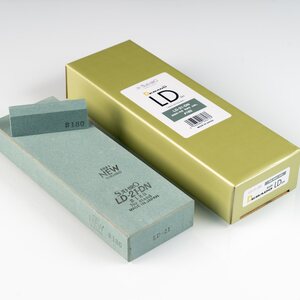
Debado LD-21 #180
56,00 €
Immediately available
(32)

When you start looking for recommendations for sharpening stones, you will almost always come across the same answer:
buy a 1000/3000 stone.
Over the years, this has become something of an industry “standard”, and customers often search for it by name. I sell these sets myself and have even built ready-made packages, such as Hiomakivi Pack V2 – 1000/3000.
But there is one significant blind spot in this recommendation – and it causes more frustration than anything else in sharpening.
There’s a saying that people go to the doctor too late.
The same applies surprisingly well to knives.
If you had sharpened your knife with a #1000 stone last year, you likely would have brought it back easily. The knife would have responded, enough metal would have been removed, and a burr – that small, detectable edge often referred to as a wire edge – would have formed in a reasonable amount of time.
But when a knife is allowed to become truly dull, you are dealing with a completely different situation.
The edge may have visible damage. The angle may have rounded over time. The knife no longer cuts – it tears.
And this is exactly the point where most people pick up their #1000 stone and start wondering why sharpening feels so difficult.
It’s important to say this clearly: a #1000 stone is not a bad choice – even as your only stone. In fact, it is one of the most important stones in sharpening.
It works very well when:
It also works well with many easier-to-sharpen knives, such as Fiskars, Ikea, Sanelli, Victorinox and Wüsthof.
These steels are typically softer and respond quickly. A burr forms, the work progresses, and the result is good. In this situation, a #1000 stone performs exactly as it should.
Simply put: it removes metal too slowly.
Sharpening is material removal. You create a new edge by removing metal until you reach the apex – and the burr tells you that you’re there.
This principle is the same for all stones. The only difference is speed.
When the edge is:
a significant amount of metal needs to be removed.
A #1000 stone can do this in theory – but in practice it often means long, heavy work.
The burr doesn’t form. The knife doesn’t seem to respond. And at this point, many people give up.
Over the years, I’ve noticed one clear pattern: the second purchase for many customers is a coarser stone, and it often happens very soon after buying a #1000 stone.
This tells you everything you need to know. Many people have the idea that “#1000 is enough for everything”.
In reality, it only works in certain situations.
When the situation is wrong, frustration is inevitable – and the correct tool will be purchased anyway, just a bit later.
A traditional Puukko (traditional Scandinavian puukko knife) has a very simple construction: a wide bevel that goes directly to the edge without a secondary bevel.
It works extremely well in use – but in sharpening it means one thing: a lot of metal needs to be removed.
The bevel is wide, and if the angle has rounded or the edge has small chips, the amount of work increases significantly.
In addition, many Puukko knives – especially older ones – are made from tough, high-quality steels. These do not respond well to slower stones, and I’ve seen cases where people have worked for up to an hour on a #1000 stone without achieving a meaningful result.
This is where a coarse stone comes in, typically in the range of #150–#400.
A coarse stone does what a #1000 cannot:
Only after this does the #1000 stone get to do what it does best – refining the edge and creating a clean, functional finish. Without this step, the process stalls before it really begins.
My recommendation is simple: choose a stone that is coarse enough – slightly too coarse is better than too fine.
In practice, two good options:
#150–250 → fast and aggressive, gets the job done clearly
#400 → more controlled and easier to manage
A useful rule of thumb: it is easier to remove #400 grit scratches with a #1000 stone than #220 grit scratches. However, if you have an efficient #1000 stone that works well with your steel, you can even jump from #180 directly to #1000.
If you are less experienced, #400 is often the safer and easier option.
A #1000 sharpening stone is not a bad choice. It is a central part of sharpening. But it is very often used in the wrong situation.
If the knife is truly dull, #1000 is not enough – you need a coarse stone first.
Once you understand this, sharpening immediately becomes easier – and more importantly, effective. If you currently only have a #1000 stone and sharpening feels difficult, you are probably not doing anything wrong. You simply have the wrong tool for the situation.
Add a coarse stone alongside it – and everything changes.