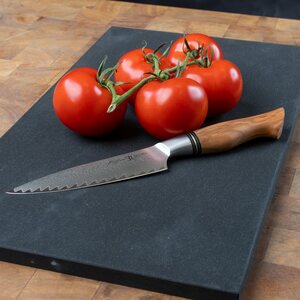
Products»Rubber Cutting Boards»ASAHI»
Parker ASAHI
Black Pro 500x330x15
198,00 €
(11)

A cutting board is one of the most important tools in the kitchen. A good knife often gets all the attention, but an equally important part of cutting is what the knife actually meets on the table. The right cutting board directly affects how well the knife keeps its edge — and how enjoyable cooking ultimately is.
In recent years, more and more people have started looking for alternatives to traditional plastic cutting boards. Microplastics and the concerns related to them have been discussed in many articles and videos. Once plastic boards are ruled out, there are really only two sensible options left: a wooden cutting board or a rubber cutting board.
A wooden cutting board — especially an end grain board — is an excellent option. It is knife-friendly, long-lasting, and, when properly maintained, also very hygienic. The downside, however, is maintenance.
A wooden board requires regular upkeep. The surface needs to be sanded from time to time, either by hand with sandpaper or with a cabinet scraper, which is an old but still very effective method. After sanding, the board needs to be treated with oil, such as paraffin oil.
And one small side note here: never go ask internet discussion forums the question “what do you use to treat a wooden cutting board?”. You will easily get 38 different answers, all completely disagreeing with one another.
My personal favorite is paraffin oil — and it has worked very well for me.
… but now I drifted a little away from the original topic.
So let’s get back to what I was actually writing about.
When choosing a cutting board for the kitchen, there are essentially three options: wood, plastic or rubber. Each material has its own strengths and weaknesses. I am intentionally leaving out glass, marble, titanium, and even wood-fiber boards, which regularly come up in certain circles and which many consumers end up trying by mistake. This blog, however, is written from the perspective of knives and sharpening, and none of those really belong in the toolkit of anyone using quality knives.
A wooden cutting board is a classic choice for many. Especially an end grain board is very knife-friendly, because the wood fibers give slightly under the knife. This reduces wear on the edge and makes cutting feel pleasant.
When properly maintained, a wooden cutting board can last for decades. The challenge is maintenance. A wooden board requires regular oiling and occasional surface sanding to stay in good condition and hygienic.
If maintenance is neglected, the board gradually dries out, may start to crack, and begins to absorb moisture and odors.
The clear downside of my personal favorite material — end grain wood — is its heavy weight. A board measuring around 50 × 30 × 5 cm already weighs enough that carrying it, for example, from the grill to the kitchen becomes a task of its own — especially if you are also trying to open doors at the same time.
Plastic cutting boards are very common in home kitchens. They are affordable, lightweight, and easy to wash. For many people, plastic boards are a familiar choice — for both good and bad reasons.
Plastic does, however, have a few clear weaknesses.
Thin plastic boards warp easily, especially if they are washed in a dishwasher or stored standing upright.
The plastic surface is often fairly hard, which wears down a knife edge more than wood or rubber. You may not notice it immediately, but over time the knife becomes dull noticeably faster.
A new and well-kept plastic board is easy to keep clean, but with use, knife grooves form on the surface. Dirt and bacteria collect easily in these grooves, which means an old plastic board can become a real breeding ground for bacteria.
In recent years, the most talked-about issue has been microplastics. When a knife cuts against a plastic board, tiny plastic particles gradually wear off the surface and inevitably end up in food as well.
A rubber cutting board sits in many ways between wood and plastic — and combines the best qualities of both.
The rubber surface has a slight give, which makes it very knife-friendly. At the same time, the material is durable and easy to clean, and it does not require the same kind of maintenance as a wooden board.
One thing many people do not know at first — or do not even believe — is the exceptional durability of these boards. I myself have said that a board can last one or even two lifetimes, because there is already decades of experience with them in professional kitchens.
Boards made from synthetic rubber, such as Asahi cutting boards, also contain no plastic. That is why they do not produce microplastics in use.
Many professionals have favored rubber cutting boards for years precisely because they combine:
More and more home cooks and professional kitchens are now choosing rubber cutting boards.
Japanese Asahi cutting boards in particular have earned a reputation for being highly durable and extremely knife-friendly.
| Feature | Wooden cutting board | Plastic cutting board | Rubber cutting board |
|---|---|---|---|
| Knife-friendliness | Good (especially end grain) | Moderate | Excellent |
| Hygiene | Good when properly maintained | Good | Excellent |
| Microplastics | No | Possible | No |
| Maintenance | Requires oiling and sanding | Very little maintenance | Light sanding when needed |
| Durability | Good, but requires maintenance | Moderate | Extremely long-lasting |
| Sound and feel | Pleasant | Hard and noisy | Quiet and soft |
| Slipperiness | Good grip | Can be slippery | Slightly tacky |
Rubber cutting boards were originally developed for the needs of professional kitchens. The goal was to find a material that combined three important qualities: good hygiene, durability, and a knife-friendly cutting surface.
In Japan, one of the best-known manufacturers is Asahi, which introduced synthetic rubber cutting boards to the market already in the 1960s. The idea for the rubber cutting board began when an Asahi representative visited the United States and came across a synthetic rubber cutting board made by Goodyear. After returning to Japan, he began developing a similar product for the local market.
During development, the aim was to find the right balance between a material that was too hard and one that was too soft. It needed to be flexible enough to protect the knife edge, while at the same time durable enough for everyday use. The final product was created after a long process of testing and development in 1965.
Asahi rubber cutting boards are made using a method called compression molding, which gives the material a dense and highly durable structure. At first, these cutting boards were used almost exclusively in professional kitchens, but gradually word of their qualities spread among home cooks as well.
In Europe, Asahi cutting boards started gaining more attention especially during the COVID years, when many people became more interested in home cooking. Interest has grown even further since the launch of the black Asahi Black Pro cutting board. At the same time, availability has occasionally been limited, as the factory’s production capacity is relatively small and demand has grown quickly.
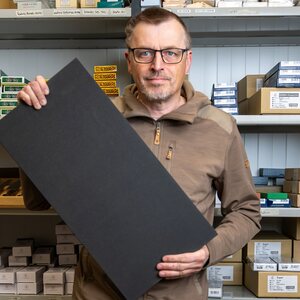 Products»Rubber Cutting Boards»ASAHI»
Parker ASAHIBlack Pro 500x330x15
198,00 €
(11)
A rubber cutting board is made from synthetic rubber or a combination of rubber and wood pulp. The material has a slight flexibility, which makes it very friendly to the knife edge.
Unlike many plastic cutting boards, rubber boards are not hard and slippery. The surface gives slightly under the knife, which makes cutting more controlled and reduces wear on the knife edge.
Many traditional cutting boards are made of plastic. One concern with plastic boards is so-called microplastics, which are created when a knife cuts against the board surface.
Asahi cutting boards are made from a combination of synthetic rubber and wood pulp. Synthetic rubber is not plastic, so the board contains no plastic and does not produce microplastics in use.
This makes it a safe choice for both home kitchens and professional use.
One of the biggest advantages of a rubber cutting board is how easy it is to maintain.
Normal washing with dish soap is enough for daily cleaning.
If knife marks begin to appear over time, the surface can easily be renewed with light sanding (grit around 120–220). This can be done by hand, but for example a random orbital sander makes the job faster.
This restores the surface to nearly like-new condition and significantly extends the lifespan of the board.
Yes. The rubber material gives slightly under the knife, which reduces edge wear compared to harder materials such as plastic, glass, or stone. The combination of rubber and wood pulp gives the cutting surface a feel that is closer to wood than to plastic.
The surface is slightly flexible and lightly tacky, which helps keep ingredients in place. The knife does not bounce against a hard surface, and cutting feels controlled and pleasant.
At the same time, the rubber material dampens sound, making cutting quieter compared to many other cutting board materials.
The cutting feel on a rubber surface is slightly different. The knife does not sink into the surface in the same way as with some other materials. Professional chefs have said, however, that after a short adjustment period, working on it feels very natural.
No. Asahi cutting boards are made from synthetic rubber and wood pulp. Synthetic rubber is not plastic, so the boards contain no plastic and do not produce microplastics in use.
Asahi cutting boards are especially known for their long service life. They have been used in professional kitchens for decades. There are even restaurants still using Asahi boards that are more than 30–40 years old. That says a lot about the durability of the material.
These numbers can easily sound like sales talk, but in practice the material really is exceptionally long-lasting.
Normal washing is enough for daily use. If knife marks begin to show on the surface, the board can easily be renewed with light sanding.
The official recommendation is not to wash the board in a dishwasher. This is mainly because high temperatures could theoretically cause the board to warp.
If the board does fit in the machine, however, many users do wash it there without problems. After washing, the board should be placed on a flat surface to cool down.
If the board becomes warped, it can often be straightened.
One way is to heat the board in a sauna, for example at around 80 °C for about 30 minutes. After that, place it on a flat surface to cool down, and if necessary, put some weight on top.
Another option is to warm the board in direct sunlight and then move it indoors to cool on a flat surface.